Turning an Internal Platform into an Enterprise-Ready SaaS Product
Management Research Services (now Agenium AI) had a highly complex, configurable enterprise platform serving life insurance underwriters. As Director of User Experience and their first UX hire, I built the UX function from the ground up while translating complex actuarial and regulatory requirements into intuitive workflows.
The core products were the Underwriting Workbench and a configurable Rules Engine built to serve two very different users: implementation teams configuring it for each carrier, and underwriters using it daily to make risk decisions. Getting both right was the central product challenge.
Key challenges
Building a product research and design function from scratch in a startup moving at high velocity
Understanding a highly technical domain well enough to drive product decisions
Balancing configurability needs across 30+ carriers alongside usability for individual underwriters
Establishing a discovery process in a startup culture that wanted to ship before learning
Problem
MRS had built a powerful platform for their own call center. To sell it to enterprise carriers, it needed to look, feel, and function like a modern SaaS product, but they had no design or product infrastructure to get it there.
Role
Director of User Experience
Impact
Straight-through processing from ~75% to ~95%
Underwriting cycle time from weeks to under one day
Secured the company's largest client, a Fortune 300 multi-line carrier, contributing ~$2M in net-new annualized revenue
Scaled to 50,000+ accounts across 30+ life insurance carriers
Discovery
MRS wanted to move quickly. They had a niche market, a working product, and an engineering team ready to build. They didn't have a clear picture of whether they were building the right things.
Before committing to a feature roadmap, I made the case to the CTO and CEO for a structured discovery phase. I proposed a tiered approach: a few quick research bets to surface immediate improvements, alongside a longer deep-dive to inform the roadmap. They agreed.
We started internally. The platform had been built by and for configuration teams, so I interviewed them first. They knew the shortcuts, the workarounds, and the gaps. Combined with an analytics review, that gave us a foundation.
I then conducted interviews and usability testing with a mix of underwriter types (new, regular, and power users) to validate assumptions and surface what the internal teams couldn't see. I also ran a competitive analysis across a dozen companies. The analysis confirmed that MRS was already winning on the things that mattered most to enterprise buyers: configurability, implementation speed, and cost of ownership. The gaps were user experience and out-of-box reporting. That became the product mandate.
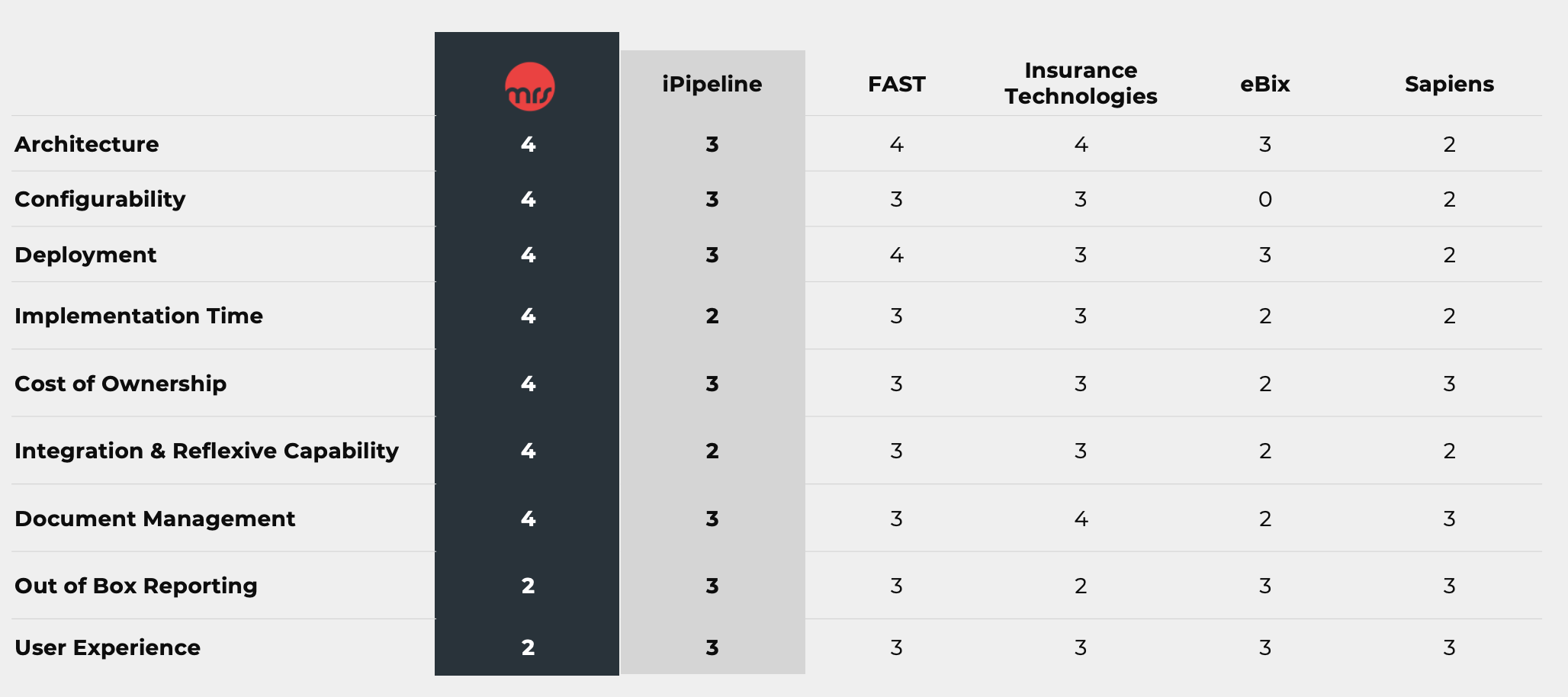
Internal competitive analysis, 2020. The two 2s at the bottom became the product mandate.
Strategy & Roadmapping
With a clear picture of the users and the market, I brought the findings to the C-level to get alignment before anyone wrote a single requirement. We needed shared agreement on what we were solving for before engineering teams started planning.
I worked with the product owner to build out the backlog, using a 2x2 framework mapping effort against importance to analyze and prioritize each item. I ran a prioritization workshop to surface the tradeoffs, then built a roadmap we could commit to. It balanced quick wins against the larger platform transformation ahead and gave engineering teams a clear direction to plan against.
The research also fed into work beyond the roadmap. I contributed to a Novarica underwriting solutions submission, which benchmarks platforms against competitors across the industry. I also built competitive positioning materials for the sales team, using the same analysis to show prospective clients where MRS had a clear edge.

UW Workbench feature roadmap, prioritized by effort and user impact.
Validation & Execution
Before handing anything to engineering, I needed to validate that the product direction we'd landed on was right. I led a cross-functional workshop to generate ideas and pressure-test assumptions, then turned the strongest concepts into rapid prototypes to put in front of clients. The direction held up.
One prospective client, RGA, came in with specific needs around data visibility and reporting. I worked with them directly in discovery sessions to map their requirements to our roadmap, then prototyped the data dashboards they needed. The prototypes validated both the product direction and the client fit.
Once we had client validation, I transitioned ownership to the agile teams. Each team had an embedded designer who reported to me. My job shifted to translating product direction into team-level work: reviewing designs, making tradeoff calls, and keeping execution aligned with what we'd learned in discovery. Testing ran alongside implementation so we could course-correct without waiting for a full release cycle.

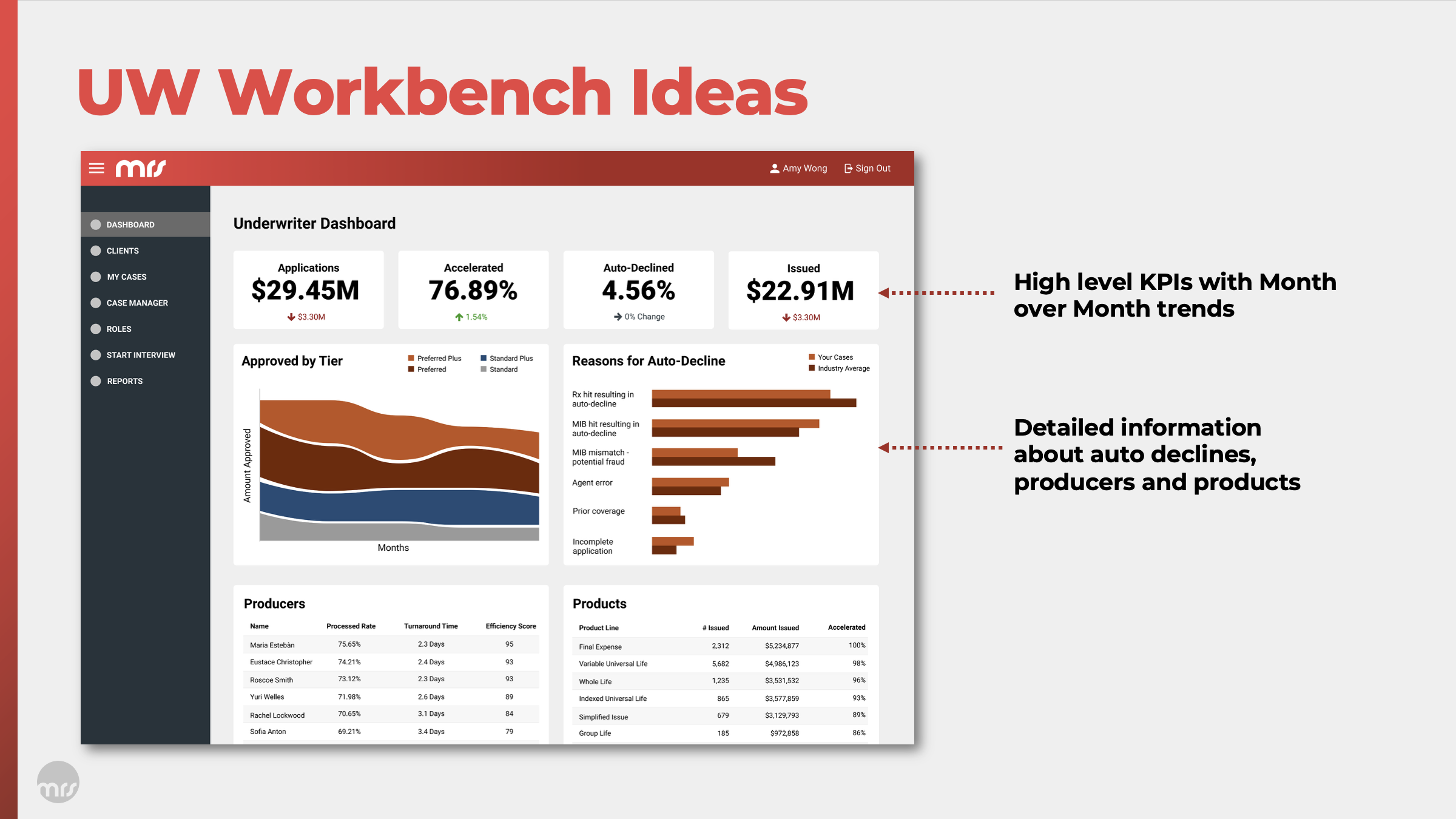
From concept experiment to client prototype
Measurement & Iteration
As the teams built, we needed infrastructure to keep them moving in the same direction. I oversaw the development of a design system that gave every team a shared set of components and standards, so we weren't making the same decisions twice across six different workstreams.
I built out KPIs and used a combination of efficiency metrics, usability testing, and NPS scores to validate that we were improving the right things. When we weren't, we adjusted.

Case Manager UI, refined through iterative usability testing and efficiency metrics.
The Outcome
RGA signed as MRS's largest client, a Fortune 300 multi-line carrier, and the close was a direct result of the product transformation. MRS had the competitive fundamentals to win: the fastest implementation timeline in the market, no upfront costs, and the most configurable platform in the space. The product work gave them a platform enterprise buyers could adopt.
The Novarica submission gave that story third-party validation, placing MRS in an industry analyst report for underwriting SaaS alongside players ten times their size.
Straight-through processing went from 75% to 95%. Underwriting cycle time dropped from weeks to under a day. Building in a domain I didn't know coming in forced a discipline I've carried since: learn it deeply enough to make decisions in it.