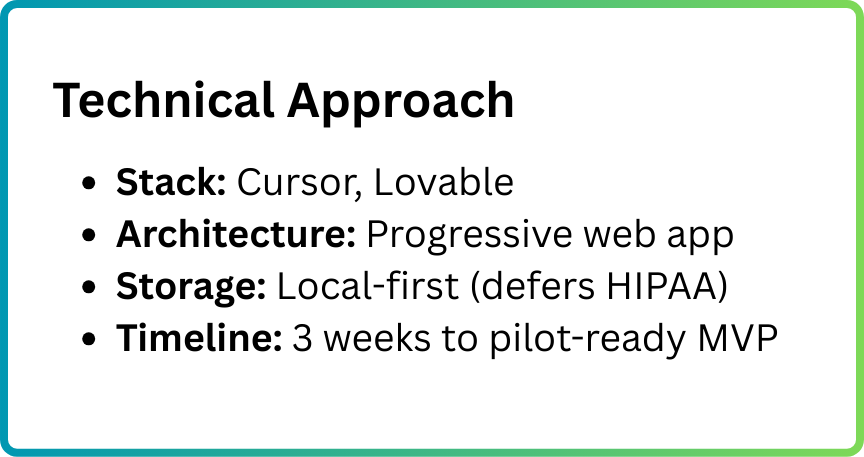
When enterprises move too slowly to ship, you have two choices: wait, or build. I chose to build.
Building accessible health tracking for older adults
Physical therapy (PT) adherence is a widespread problem with serious health consequences. 1 in 4 older adults with cognitive challenges do not adhere to their physical therapy. Even among the general population, PT adherence is only around 70%. The consequences are significant: poor adherence correlates with worse physical function, slower recovery, and diminished quality of life.
I personally experienced this. Despite being highly organized, I struggled to maintain a complex PT routine. Morning meetings pushed exercises aside, workday pressures made me forget, and by evening my shoulder pain made catching up impossible. This isn’t an uncommon problem. Patients forget exercises, skip reps, or simply lose motivation.
The combination of cognitive load, memory challenges, and lack of timely support creates a perfect storm for non-adherence and worse health outcomes.
The challenge
Alpha version in testing with users
I initially approached this like many product people do when excited about a solution: I jumped straight into Lovable and started coding a web app. I was extremely excited to move fast and see my vision immediately come to life. But within a few days, I recognized I was making a fundamental product mistake: I fell in love with the solution, instead of the problem.
I backed up and recentered on the core challenge: how do you keep an app exceptionally simple for people with memory challenges, while still providing enough motivation and progress tracking to maintain adherence?
The answer required rethinking where complexity lives. Instead of forcing users to navigate complicated interfaces daily, I designed a setup wizard that front-loads configuration. A physical therapist, home care worker, or family member can help establish the exercise routine and notification schedule once. After that, daily interaction is extremely simple: tap to confirm you've completed an exercise, see your progress, get positive reinforcement.
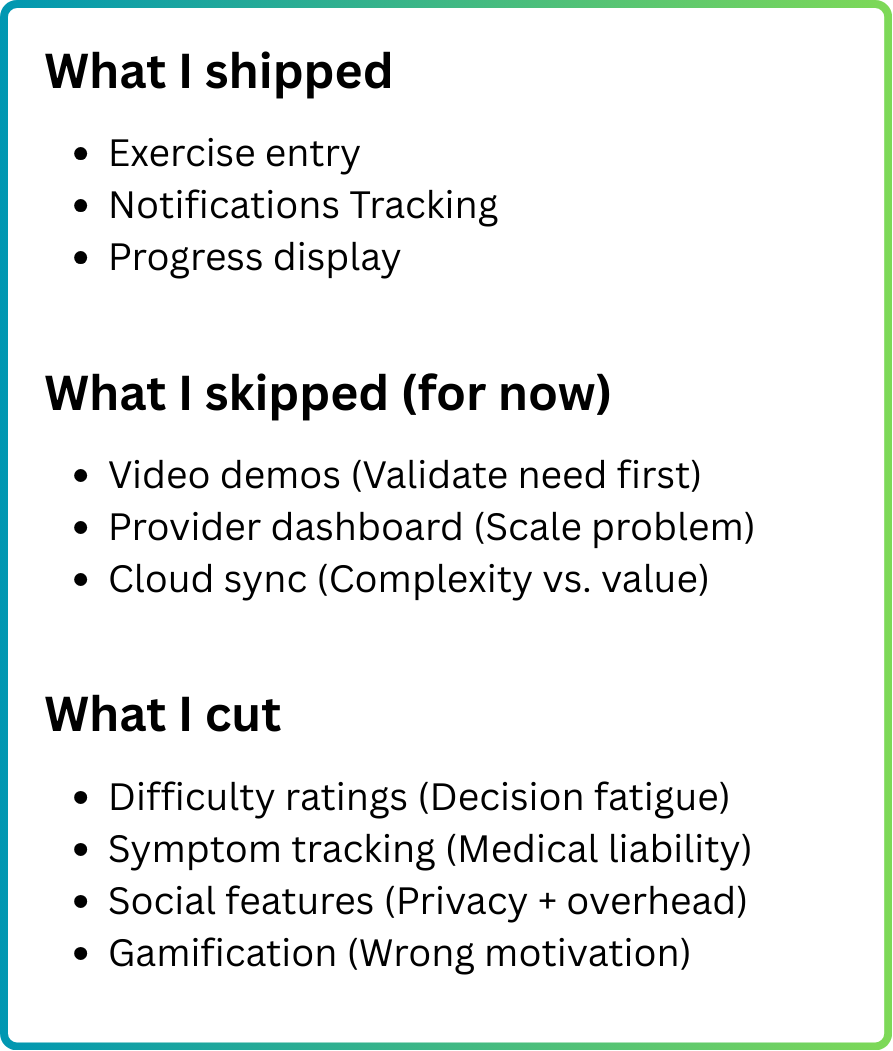
The MVP focused on three core functions: manually adding exercises, setting up exercise-specific notifications, and tracking completion. The setup wizard handles configuration complexity once; daily interaction is just tap to confirm.
I deliberately excluded features like difficulty ratings and symptom tracking; not because they aren't valuable, but because they would compromise the simplicity that makes the app accessible to my target population.
Every feature must prove it reduces friction before it ships. Cognitive load is the enemy of this app.
My approach
I'm currently testing the web app myself daily and have partnered with a local physical therapy company to pilot it with eight patients. Early retention signals are promising, though sample size remains small.
Success will be measured against clear benchmarks. Current research shows PT adherence rates under 40% for older adults with cognitive challenges. If this app can double that adherence rate, the health outcomes could be substantial. I don't expect people to heal twice as fast, but even a 25% reduction in recovery time would represent meaningful improvement in quality of life and healthcare costs.
Where it stands
This project reminded me why I got into product work: I wanted to build again. AI technology moves too quickly to stay relevant through strategy alone. You need to get your hands dirty. But building without product discipline is just coding. The real value was catching myself before I shipped the wrong thing.
The speed of modern AI development tools makes it dangerously easy to jump to implementation without deeply understanding the problem. I initially fell in love with the solution instead of the problem. Backing up to focus on "insanely usable" rather than "feature-rich" reinforced a core product principle: constraints drive better design.
Building for the hardest use case, older adults with memory challenges, forced simplicity that ultimately serves everyone better. This is the kind of strategic constraint I bring to enterprise product work: finding the constraint that clarifies everything else. In enterprise environments, it's navigating organizational complexity while maintaining velocity. Here, it was designing for cognitive limitations while maintaining adherence. Different contexts, same product principle: constraints drive better outcomes.