Portfolio Leadership & Transformation for Enterprise Innovation
Role
Head of Tech Innovation
Outcomes
Built stage-gated innovation process and portfolio governance framework; transformed $500K fund into venture-style investment vehicle; launched Innovate For Impact employee training program; led team of 6 (2 PMs, 1 Solution Designer, 3 rotational ICs)
Focus
Innovation strategy, organizational transformation, portfolio management, stakeholder relationship building, capability building
Molson Coors Beverage Company is a global beverage leader with 17,000 employees across brewing, distribution, and commercial operations. As tech moves continually faster and business needs evolved, the company needed to bring innovation capabilities across teams, not just in one centralized function.
After spending months enabling business teams through discovery and strategy work, I pitched myself for the Head of Tech Innovation role. I knew we could transform innovation from a black box into something that enabled product teams, broke down silos, and delivered measurable ROI.
Key challenges
Rebuilding stakeholder relationships and trust in innovation's value after years of unclear outcomes
Shifting the team from long, unclear project work to rapid, stage-gated product experimentation and delivery
Enabling innovation across product teams who were previously 100% allocated to delivery work
Proving business value quickly while building long-term organizational capability
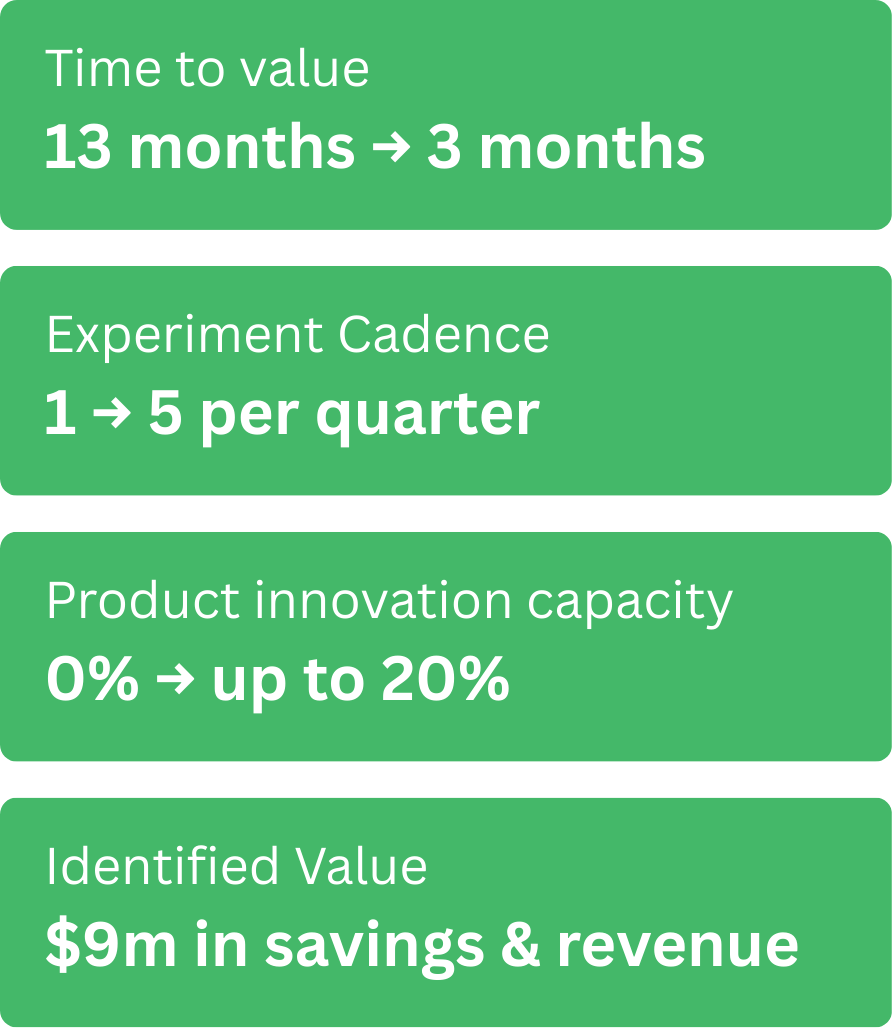
Business impact: Over 12 months, we compressed median time-to-value from 13 months to 3 months and delivered $8M+ in cost savings and revenue opportunities. Product organizations now dedicate up to 20% of capacity to innovation. Key initiatives included AI Translation (99.95% cost reduction, $1M annual savings), a Connected Worker initiative rolling out to all breweries, and an eCommerce partnership targeting $6-8M in value. The function went from isolated and distrusted to a strategic partner teams actively sought out.
Strategic Approach
Process transformation The team had been running experiments without clear stages or success criteria. I introduced a stage-gated process with defined metrics at each stage and a focus on "tiny loops" (rapidly proving out ideas, pivoting, or moving on).
Stakeholder relationships Building trust required transparency and partnership. I learned stakeholder roadmaps and business priorities, shared what we were working on openly, and created pathways to collaborate on pilots rather than working in isolation. I built partnerships with R&D Engineering and IT leadership, teams that hadn't previously engaged with innovation. These relationships became the foundation for embedding innovation into their delivery processes.
Funding model We had a $500K innovation fund that had been used for training and staff augmentation (anything other than innovation). I transformed it into a venture-style fund focused on experiments the organization wasn't quite ready for yet, giving us runway to pilot higher-risk ideas while building psychological safety around experimentation.
Identify ideas that align to a strategic business purpose

Incubate with continuous discovery and lean canvas

Experiment rapidly to assess overall viability & feasibility

Pilot and co-build directly with product teams who own solution

Scale only the pilots that reach certain metric thresholds

Revamped five-stage process to evaluate innovation ideas
Enabling the Team
Internal team transformation The team had incomplete and inaccurate job descriptions with no clear progression. I rebuilt the role structure to create a career path from level 10 up to 13, giving the team clarity on expectations and growth opportunities. I also developed their tactical capabilities in areas they'd been missing: facilitation, product discovery, rapid prototyping, and validation techniques.
Building capability across IT Decentralizing innovation meant shifting the culture so teams saw innovation as part of their core work, not something a separate function owned. I created upskilling opportunities like Innovate For Impact, a 6-week innovation challenge in partnership with a local non-profit where employees built real innovation muscle through hands-on work. Combined with transparent collaboration and delivering visible wins, product organizations began dedicating up to 20% of their capacity to innovation (not because it was mandated, rather because they now had the skills and saw the value).
Our internal innovation challenge, Innovate for Impact
Key Initiatives
AI Translation Translation had been sitting in our backlog since 2023. When a major SAP transformation budgeted $750K for translation services, we piloted an AI-powered solution that achieved 99.95% cost reduction, cutting costs to under $10K while reducing turnaround from days to minutes. We instituted human-in-the-loop QA and enterprise AI guardrails for a global rollout delivering $1M in annual savings.
eCommerce Revenue Partnership A high-potential eCommerce partnership targeting $6-8M in revenue came to us because stakeholders now trusted innovation to lead revenue-critical work. The project cost under $15K to execute and represented a turning point: we'd rebuilt enough credibility to be brought in on strategic business opportunities, not just cost-saving experiments. This validation proved the transformation had stuck.
AI Enterprise Strategy Beyond individual projects, I influenced AI strategy at the ELT and Board levels, shaping enterprise-wide decisions on funding, training, and guardrails. This positioned innovation not just as a delivery function, rather as a strategic voice in how the company approached emerging technology and organizational capability building.
What I Learned
Influencing strategy at the board level requires demonstrating clear business value, not just talking about innovation potential. Leading with a strong business case and building the right partnerships created permission to do ambitious work that would have been dismissed as too risky otherwise. Scaling innovation isn't about process mandates or methodology training. It's about delivering visible wins that make teams want to dedicate capacity to experimentation. Trust and capability compound when people see innovation actually work.