Research your next company
I worked in consulting for years. I loved it. Then suddenly overnight it felt like the company had changed and I needed to get out.
I was in my mid-twenties and had no framework for evaluating a future role. I read the role, I read the salary, and if both looked right, I applied. I spent two years bouncing: into marketing, into a startup, and even three short weeks at a consulting firm. Even my next long-term role wasn't a great fit. It just wasn't a bad enough fit, and that was good enough at the time.
I don't want that for you. I know the job market is hard right now and sometimes you just have to hustle. If you can afford to be selective, you should be. I built a researcher that tells you whether a company is worth it before you write the cover letter. It's tailored to look at growth, culture, and reputation, but you can make it your own based on what matters to you.
Grab the files from Github
The setup
The researcher runs with any GenAI tool that has web access. Give it a company name and it works through five areas: company overview, funding and financial signals, growth trajectory, leadership stability, and culture and reputation. At the end you get a verdict: Pursue, Watch, or Skip. The verdict comes with a confidence rating based on how much reputable information it found.
There is just one prompt and two folders that you’ll need:
system-prompt.md is the startup file. It tells your assistant what to research, how to structure the findings, and where to save the results. There are no other files to configure. Load this and give it a company name.
Research/ is where the profiles save. One markdown file per company, named by company slug. You build up a library as you go.
Research/index.md is the running log. Every company you've researched, with verdict, confidence level, date, and notes. Over time it becomes a target list: where you're actively pursuing, what you're watching, what you've ruled out and why.
The template
There's nothing to fill in before your first session. The README walks through three ways to set it up: as a Claude Project, in a plain chat, or in a Cowork session. Load the system prompt, give it a company name, and it runs.
After the research it asks if you have any additional knowledge to factor in, like a contact in your network, a reputation you've heard, or even a past interview. If you do, it folds that in and updates the verdict.
Use the confidence rating in addition to the job match. A well-funded Series C company with years of press coverage will have enough data to be high confidence. A 30-person startup with one TechCrunch mention and no Glassdoor reviews is low confidence. Without a high or medium confidence rating, you shouldn't trust the verdict. (That doesn't mean you shouldn't apply - but go in asking good questions!)
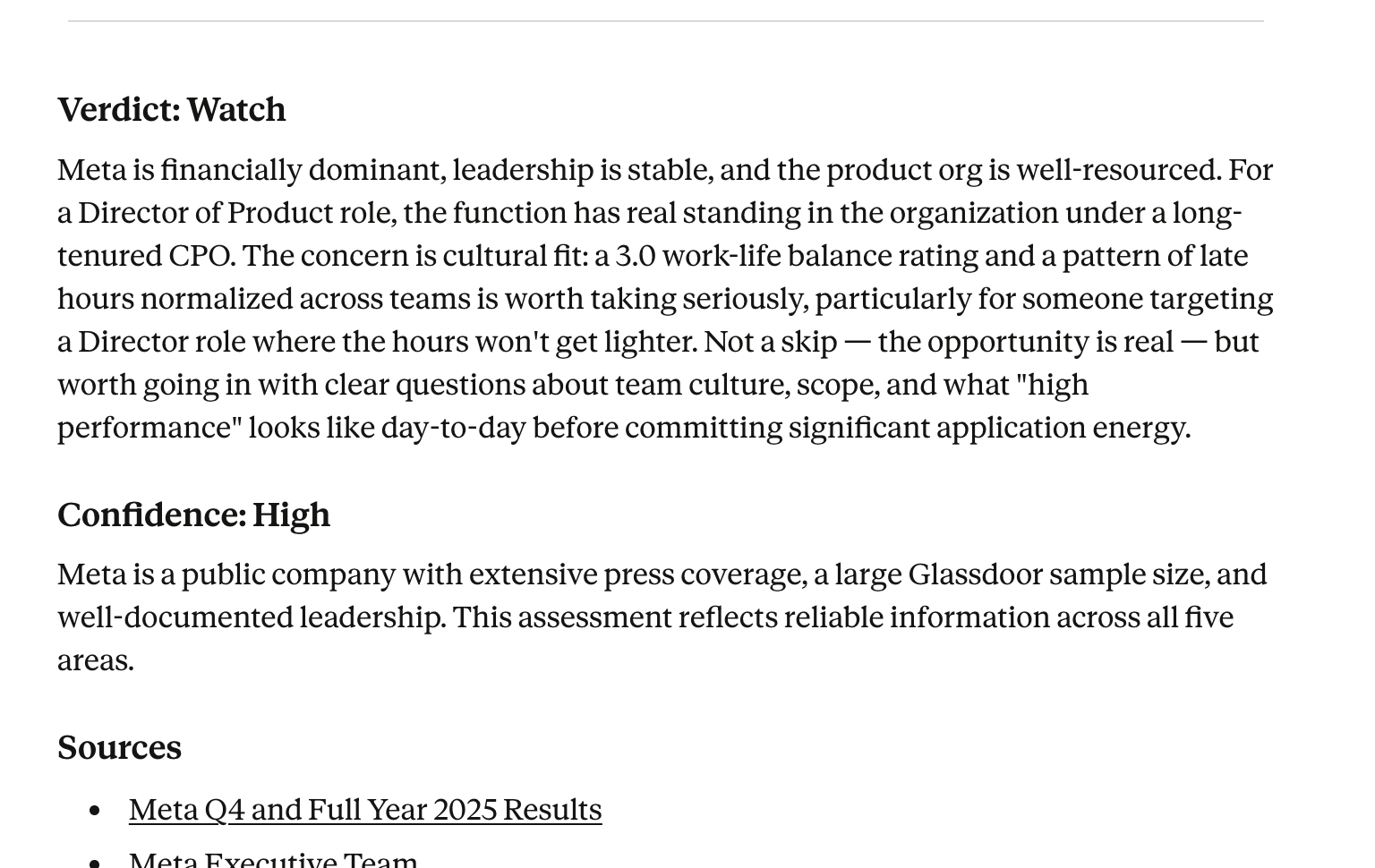
What an analysis looks like (based on my resume and a real job that I applied to)
Building your job prompts
This prompt is designed to work alone or in tandem with the other prompts I've published to Github. You can use any (or all) of these in any order, but I would recommend analyzing an open role, using this prompt to research the company, and then writing your cover letter.
